
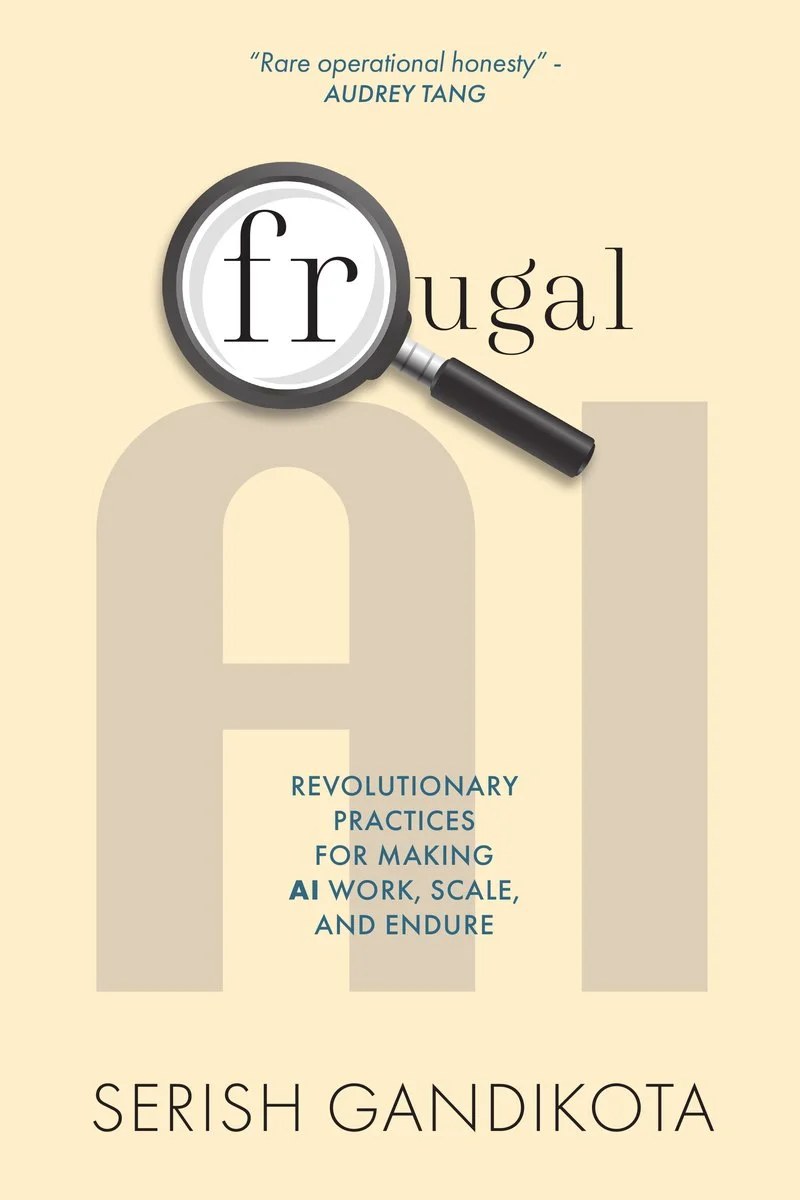
The book
Frugal AI
Revolutionary Practices for Making AI Work, Scale, and Endure
Serish Gandikota
Artificial intelligence is moving into institutions faster than institutions are learning how to hold it. Frugal AI examines the distance between what AI can do and what an institution can responsibly absorb, and the architecture required to close it.
“Rare operational honesty”Audrey Tang, co-author of Plurality; Cyber Ambassador of Taiwan
The argument
AI creates lasting value when institutions are designed to hold it.
Across sectors, capability arrives, workflows strain and costs surface. Systems that performed impressively in demonstration become difficult to sustain in practice. The decisive variable is increasingly the distance between what AI can do and what an organisation can responsibly absorb.
The pattern appears wherever AI moves from pilot to production. An NHS trust finds that a clinical documentation system was never costed for routine use across its wards. A European manufacturer learns that AI quality control built for a stable cloud connection breaks when shop-floor connectivity fluctuates. Enterprise teams discover that running models continuously across real workflows costs an order of magnitude more than their pilots suggested.
MahaVISTAAR, Maharashtra’s voice-based agricultural advisory system, shows what deliberate design makes possible. Built for the conditions it would actually operate in, it reached roughly 2.5 to 3 million farmers by early 2026, and the documented decisions behind it allowed teams to adapt it for Ethiopia in three months and for Amul’s dairy cooperative in three weeks.
“Adoption is often confused with absorption. The difference is the difference between adopting a child and raising one.”From the Prologue
Extract
From the Prologue: The Architecture of What Comes Next
The opening pages of the book.
Artificial intelligence is moving into institutions faster than institutions are learning how to hold it. Across sectors, capability arrives, workflows strain, costs surface, and systems that performed impressively in demonstration become difficult to sustain in practice. The decisive variable is increasingly the distance between what AI can do and what an organisation can responsibly absorb. This book examines that distance, and the architecture required to close it.
This book gives that design logic a name: Frugal AI. It is a design philosophy, developed here as a theory of deployment rather than a theory of technology. What determines whether artificial intelligence creates durable value is not the power of the model but the readiness of the institution, the design of the system surrounding the model, and the deliberateness with which cost, governance, and control have been built in from the beginning. These are design variables, and they can be managed. A deploying organisation is not obliged to accept the model, the workflow, the cost structure, and the pattern of dependency as a single package; each can be chosen, and choosing them deliberately is what this book means by design. The Absorption Gap, the Frugal Stack, Total Cost Architecture, and the Sovereign Spine are complementary lenses on that shared design logic, each illuminating a different dimension of what it takes to build intelligence that holds.
The language most organisations use for this moment is adoption. They adopted a system. They deployed a capability. Adoption is an event word: it names a crossing rather than what comes after it. The harder word is absorption, and it describes something closer to what actually determines whether an AI system creates lasting value. Adoption is often confused with absorption. The difference is the difference between adopting a child and raising one. The first is an event. The second is a commitment that begins when the paperwork is complete.
From Frugal AI by Serish Gandikota (Global Resilience Publishing, 2026).
The frameworks
Five complementary lenses
Frugal AI is the design philosophy. These lenses are complementary ways of seeing what it requires.
01 · Prior condition
Sufficiency Test
Does this workflow require AI at all?
02 · Diagnostic
Absorption Gap
The distance between what a system can do and what an institution can sustain.
03 · Design framework
Frugal Stack
Five layers (compute, model, data, orchestration, governance) that must align for a system to hold.
04 · Economic methodology
Total Cost Architecture
How design choices create, move and amplify cost across the Stack, including the layers procurement leaves uncosted.
05 · Positioning practice
Sovereign Spine
At each layer of the Stack: what must be controlled, what can be influenced, what may safely be rented.
Advance praise
Early readers
Advance praise from Audrey Tang, Carlota Perez, Diane Coyle, Vivek Lall, Navi Radjou, Kentaro Toyama and twelve others.
Get the book
Indian edition first, international edition in 2027
Indian edition · November 2026
Distributed in India and South-East Asia by Penguin Random House India.
Paperback Rs 799 · Hardback Rs 1,295
UK, Europe and North America · 2027
Published by Global Resilience Publishing, Cambridge.
Paperback £16.99 · US$22.99 · CA$29.99 · A$34.99
Hardback £25.00 · US$32.00 · CA$39.99 · A$55.00
Hardback ISBN 978-1-913738-77-8 · Paperback ISBN 978-1-913738-86-0 · 242 pages · Also as e-book and audiobook · Publisher’s page
The book and the Hub
Where the ideas are tested
The book sets out the full framework behind the Hub’s work. The Hub’s white papers apply parts of it to particular sectors and partners, and its Deployment Labs test it in the field.
To invite the author for a talk or a book event, get in touch.