
Frugal AI Hub · Cambridge Judge Business School
AI that institutions can absorb, govern and sustain
AI capability is arriving faster than institutions can sustain it. The Frugal AI Hub at Cambridge Judge Business School studies that gap, and works with governments, companies and researchers on what it takes to close it.
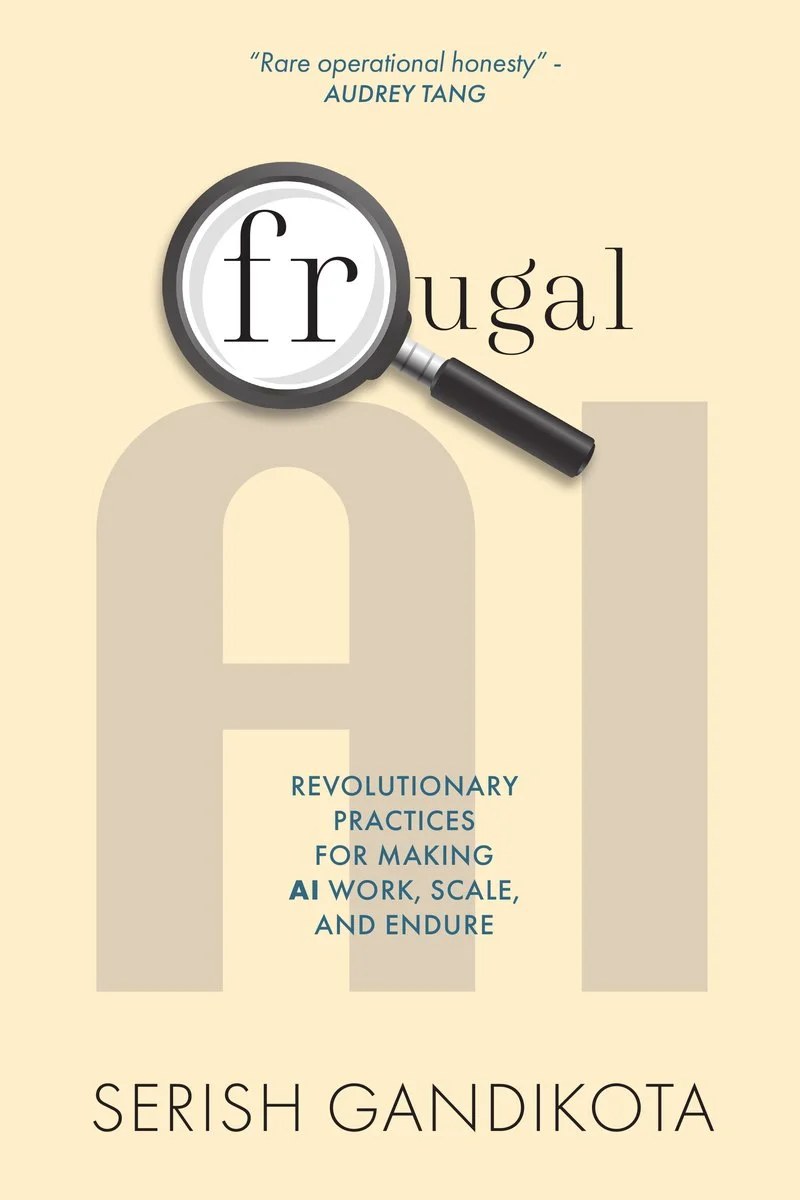
New book · November 2026
Frugal AI
Revolutionary Practices for Making AI Work, Scale, and Endure
By Serish Gandikota, co-founder of the Hub. The full argument behind the Hub’s work on absorption.
The problem we work on
Most AI stalls between the pilot and everyday use.
Organisations adopt AI quickly. Far fewer absorb it: fit it into the work people actually do, pay for it over its whole life, govern it, and keep it running when the project team moves on. Pilots rarely show the full cost, the energy and infrastructure a system draws on, or who it fails to reach.
Frugal AI is our response. It is an outcomes-first design discipline: start from the result an institution needs, work within its real constraints, and use what is sufficient to deliver it.
Our work
Three strands
Research sets the questions and the measures. Deployment Labs test them with partners in live settings. The ecosystem spreads what we learn and brings in the next problems.
01 · Research
Research
Evidence on why AI stalls and what lets it last: absorption, whole-life cost and value, sufficient design, and community-governed AI for low-resource languages.
02 · Deployment
Deployment Labs
Work with public institutions on live AI challenges, measured from the first day, to learn what it takes for a system to be deployed, governed and sustained in a specific place.
03 · Ecosystem
Ecosystem
Partnerships, workshops and executive education that bring together the people who build AI and the people who have to make it work.
Publications
Selected reports
Three recent reports from the Hub and its partners. The full set of eight is on the publications page.
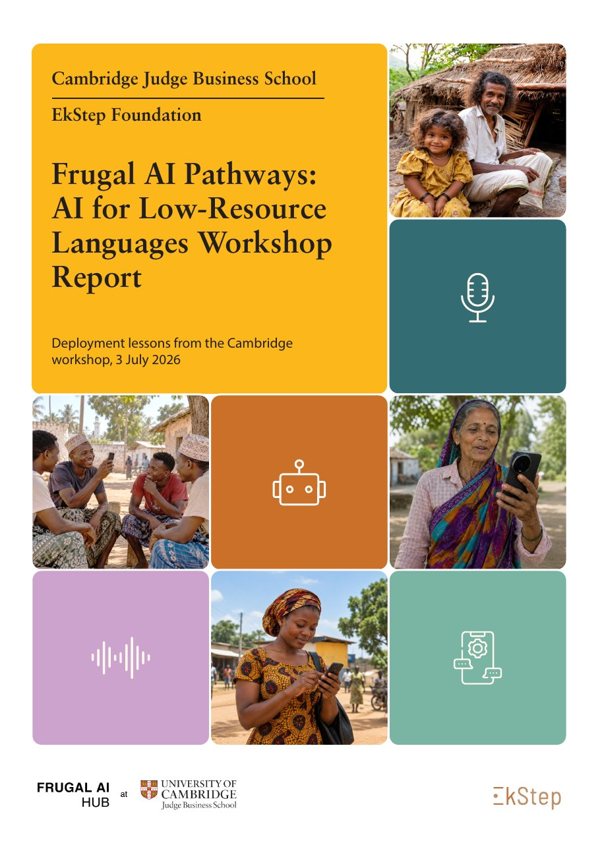
Frugal AI Pathways: AI for Low-Resource Languages
Deployment lessons from the workshop the Hub convened in Cambridge on 3 July 2026. Practitioners who have deployed voice and language AI worked with teams starting out, including the Soliga and Swahili deployments. Seven working observations and seven open questions.
With EkStep Foundation · 100 AI Diffusion Pathways

Minds, Models and Markets
A UK–India AI corridor report: how the two countries’ strengths in talent, models and markets can combine, read through Frugal AI and institutional absorption.
With Prachetas Bhatnagar

From Total Cost of Ownership to Social Impact
A three-level framework for measuring an AI portfolio as a strategic asset: whole-life cost, return on investment, and impact aligned with the Sustainable Development Goals.
With the UNICC AI Hub
Working with
Partners on recent work
Government of Andhra Pradesh
A memorandum of understanding with Cambridge Judge Business School, signed in November 2025. The first Deployment Lab is being set up in the state.
UNICC AI Hub
A shared framework for measuring AI portfolios, from total cost of ownership to SDG impact.
EkStep Foundation
Frugal AI Pathways and the 100 AI Diffusion Pathways initiative.
IIIT Dharwad
Frugal Voice: community-governed speech models with the Soliga community.
Global Education Lab
Research and executive education on leading organisations through AI.
Work with the Hub
We work with public institutions, companies and research partners that need AI to keep working once the pilot ends. Tell us about the problem you are working on.